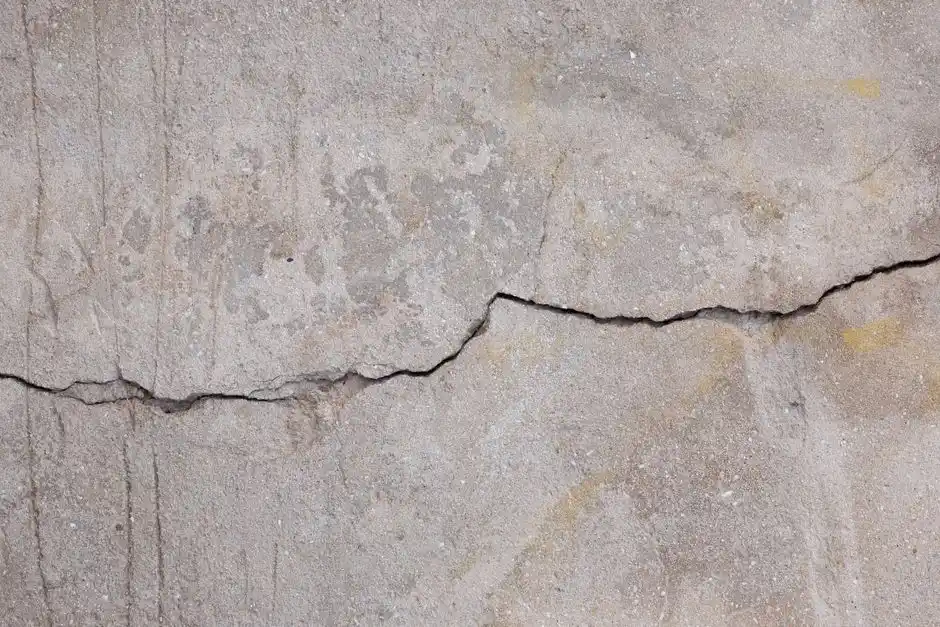
To repair a cracked concrete patio before winter in San Diego, clean the crack, widen it slightly with a chisel, fill it with a flexible polyurethane sealant or concrete patching compound, and seal the entire slab before the first significant rain. The whole job takes a weekend for most patios and costs $50-$300 in materials if you do it yourself. San Diego's winter rain season starts in November and runs through March, so any crack wider than a credit card needs attention now - water that gets in, freezes overnight in the mountains, and expands will turn a hairline crack into a broken slab by spring. This guide covers why local patios crack, the exact repair steps, 2026 pricing, and when a professional repair makes more sense than a DIY patch.
Why San Diego Patios Crack Before Winter
San Diego patios crack before winter because the region's dry summer shrinks clay-heavy soil, and the first rains of November re-expand it fast - moving the slab unevenly underneath. That movement is the number one cause we see on patios from Chula Vista to Encinitas. Coastal areas like Pacific Beach and Ocean Beach add salt air and marine moisture that weaken the surface over time. Inland neighborhoods like El Cajon and Santee swing harder between 90°F summer afternoons and 40°F winter nights, and that thermal cycling stresses every control joint.
Most of the patios we inspect were poured 15-30 years ago, often without a proper gravel base or rebar grid. When the soil moves, the slab has nothing holding it together. A 1/16-inch crack in October becomes a 1/4-inch crack by January, and once water sits in it through a few rain events, the edges start spalling. That is why fall is the right time to act - not spring.
How to Repair a Cracked Concrete Patio Before Winter in San Diego CA
How to repair a cracked concrete patio before winter in San Diego CA depends on the crack type. You are not just filling a gap - you are stopping water from getting under the slab before the rain starts. Match the repair to the crack:
- Hairline cracks (under 1/8 inch): Seal with a concrete crack filler or self-leveling polyurethane sealant. These are cosmetic and stable - a $15 tube of sealant handles 20 linear feet.
- Medium cracks (1/8 to 1/4 inch): Clean, widen slightly, and fill with a flexible polyurethane sealant designed for concrete. Do not use rigid epoxy outdoors in San Diego - it cracks again with soil movement.
- Wide or offset cracks (over 1/4 inch, or one side higher): This is a structural issue. The slab has moved, and filling the crack alone will not fix it. You need concrete leveling or slab replacement.
- Multiple cracks in a spiderweb pattern: Usually a sign of a failing base or a slab poured too thin. Patching individual cracks is a waste of money - resurfacing or replacing the slab is the real fix.
If your patio has more than three or four cracks, or any crack wider than a pencil, stop and get it looked at before you spend money on sealant. We handle Concrete Patio Repair San Diego CA every week, and the honest answer is sometimes that a $200 DIY patch will fail by February.
What Causes Concrete Patio Cracks in San Diego?
Concrete patio cracks in San Diego come from five things: soil movement, poor drainage, tree roots, thermal expansion, and age. Here is what each one looks like and how to tell them apart.
Soil Movement and Clay Soil
Much of San Diego County sits on expansive clay that swells when wet and shrinks when dry. A patio poured on clay without a proper base moves every season. You will see cracks that open in October and close in April.
Poor Drainage and Standing Water
If your patio slopes toward the house or a low spot holds water after rain, that water is working its way under the slab. Look for dark stains, moss, or a crack that runs parallel to the house - those are drainage cracks.
Tree Roots
Ficus, eucalyptus, and palm roots are common culprits in older San Diego yards. Roots lift one side of the slab, creating an offset crack. You cannot seal your way out of this one - the root has to be addressed.
Thermal Expansion and Contraction
Inland San Diego sees 50°F day-to-night swings in fall and winter. Without proper expansion joints every 8-12 feet, the slab pushes against itself and cracks. If your patio has no visible joints, this is likely your cause.
Age and Surface Wear
Concrete gets weaker over decades. A 25-year-old patio with surface scaling and fine cracks is a candidate for resurfacing, not patching. We install Concrete Expansion Joint Installation San Diego CA on older patios to stop the crack cycle before it restarts.
DIY Concrete Patio Repair San Diego: Step-by-Step
DIY concrete patio repair in San Diego is realistic for hairline and medium cracks. For anything wider than a quarter inch, or any crack with vertical offset, call a pro. Here is the process we recommend to homeowners who want to handle it themselves.
- Wait for a dry stretch. San Diego's fall is usually dry through early November. You need 24-48 hours of no rain for sealant to cure.
- Clean the crack. Wire brush, then compressed air or a shop vac. Any dirt left in the crack prevents the sealant from bonding.
- Widen slightly with a cold chisel. You want a V-shape about 1/4 inch wide at the top. This gives the sealant something to grip.
- Insert backer rod. For cracks deeper than 1/2 inch, foam backer rod keeps the sealant from sinking. Leave the sealant depth at about 1/4 inch.
- Apply flexible polyurethane sealant. Self-leveling for flat patios, non-sag for sloped or vertical surfaces. A standard 10-ounce tube covers about 20 linear feet at 1/4 inch.
- Tool the joint. A putty knife or joint tool smooths the sealant and pushes it into the crack walls.
- Cure 24-48 hours. Do not walk on it, and definitely do not let the sprinklers hit it.
- Seal the whole slab. A penetrating concrete sealer keeps future water out and extends the life of the repair. This is the step most homeowners skip - and the one that matters most before winter.
If your patio is stamped or has a decorative finish, test any sealant on a hidden spot first. Some products discolor decorative surfaces. For those patios, we usually recommend a Concrete Sealing San Diego CA service that uses a breathable sealer matched to the finish.
Cost to Repair Cracked Concrete Patio San Diego CA
The cost to repair a cracked concrete patio in San Diego CA in 2026 runs $250 to $1,500 for most residential jobs, depending on crack severity and patio size. Here is how the numbers break down:
- DIY materials: $50-$300 for sealant, backer rod, chisel, and a sealer for a 300-square-foot patio.
- Professional crack sealing: $250-$600 for a typical 300-500 sq ft patio with 20-40 linear feet of cracks.
- Concrete leveling (mudjacking): $600-$1,800 for a settled slab that needs lifting before sealing.
- Resurfacing or overlay: $3-$7 per square foot, so $900-$2,100 for a 300 sq ft patio.
- Full replacement: $8-$15 per square foot, or $2,400-$4,500 for a 300 sq ft patio, including removal and disposal.
Those numbers assume easy access and no tree root removal. If a ficus root has lifted the slab, add $300-$800 for root work and base repair. We give written, itemized pricing before any work starts, so you know the number before we pick up a tool. For patios that are too far gone to patch, we handle Concrete Removal & Replacement San Diego CA and can usually complete a standard patio in two to three days.
Common Mistakes to Avoid
The most common mistake we see is filling a moving crack with rigid epoxy. Epoxy is strong, but it does not flex - and San Diego's clay soil moves. The epoxy cracks again within one season, and now the crack is harder to repair because the edges are contaminated.
Other mistakes:
- Sealing over a wet or dirty crack. The sealant peels out within months.
- Ignoring vertical offset. If one side of the crack is higher, the slab has moved. Filling it hides the symptom, not the cause.
- Skipping the sealer. A patched crack without a slab sealer lets water in through the surrounding surface.
- Repairing in the rain. San Diego's first storm usually hits mid-to-late November. Watch the forecast and pick a dry 48-hour window.
- Using the wrong product on stamped concrete. Some sealants yellow or cloud decorative finishes.
When to Call a Professional
Call a professional when a crack is wider than 1/4 inch, when one side of the crack sits higher than the other, when you have more than four or five cracks, or when water pools on the patio after rain. Those are signs the problem is under the slab, not on it.
We also get called when a homeowner has already tried a DIY patch and it failed. That is fine - we would rather fix it right than have you spend another $200 on sealant that will not hold. Our team walks the patio, checks the slope and drainage, and tells you honestly whether a patch, a leveling job, or a full replacement is the right call. If you are in an older neighborhood like North Park or La Mesa, where 1940s-1960s slabs are common, we see this constantly and can usually give you a clear answer on the first visit.
Frequently Asked Questions
How do I repair a cracked concrete patio before winter in San Diego?
Clean the crack, widen it to a V-shape, fill with flexible polyurethane sealant, and seal the entire slab. Do this in a dry 48-hour window before the first rain, usually by early-to-mid November in San Diego. Cracks wider than 1/4 inch need professional repair.
What causes concrete patio cracks in San Diego?
Expansive clay soil, poor drainage, tree roots, thermal swings, and age. San Diego's dry summer followed by winter rain moves the soil under the slab, and that movement is what cracks the concrete. Coastal salt air and inland temperature swings make it worse.
Can I repair concrete patio cracks myself in San Diego CA?
Yes, for hairline and medium cracks under 1/4 inch. DIY materials run $50-$300 and the job takes a weekend. Cracks wider than 1/4 inch, offset cracks, or spiderweb patterns need a professional - those signal a base or slab problem a patch will not fix.
How much does concrete patio repair cost in San Diego?
In 2026, professional crack sealing runs $250-$600 for a typical patio. Leveling adds $600-$1,800. Resurfacing is $3-$7 per square foot, and full replacement is $8-$15 per square foot. DIY materials cost $50-$300.
How long does concrete patio repair take?
DIY crack sealing takes one weekend including cure time. Professional crack sealing is usually a half-day. Leveling takes one day. Resurfacing takes two to three days, and full replacement takes two to four days depending on access and disposal.
Get Help with Concrete Contractor in San Diego
If your patio has cracks wider than a pencil, or you want it sealed before the first real storm hits, we can take a look this week. We serve homeowners across San Diego County, from Chula Vista to Oceanside, and we will tell you straight whether you need a patch, a leveling job, or a new slab.
Call San Diego Concrete Contractor at +16192311616 for a free estimate on concrete patio repair before winter.